Government Clarifies: Temporary Means Permanent Until Challenged in Court
In a bold demonstration of modern governance, federal officials confirmed this week that a group of individuals who entered the country illegally were granted temporary work status, quickly followed by commercial driver’s licenses, despite limited English proficiency and minimal familiarity with American road signage, traffic laws, or the concept of an “oncoming lane.”
Officials insist the program was rooted in compassion, efficiency, and a belief that trucking—an industry involving multi-ton vehicles traveling at highway speeds—was an ideal entry-level occupation.
According to reports, roughly 17,000 licenses were issued under the temporary program. The drivers were immediately placed behind the wheel of commercial trucks, a move regulators described as “inclusive,” “forward-thinking,” and “not something we had time to overthink.”
After several accidents—some involving fatalities—the issue finally drew public attention.
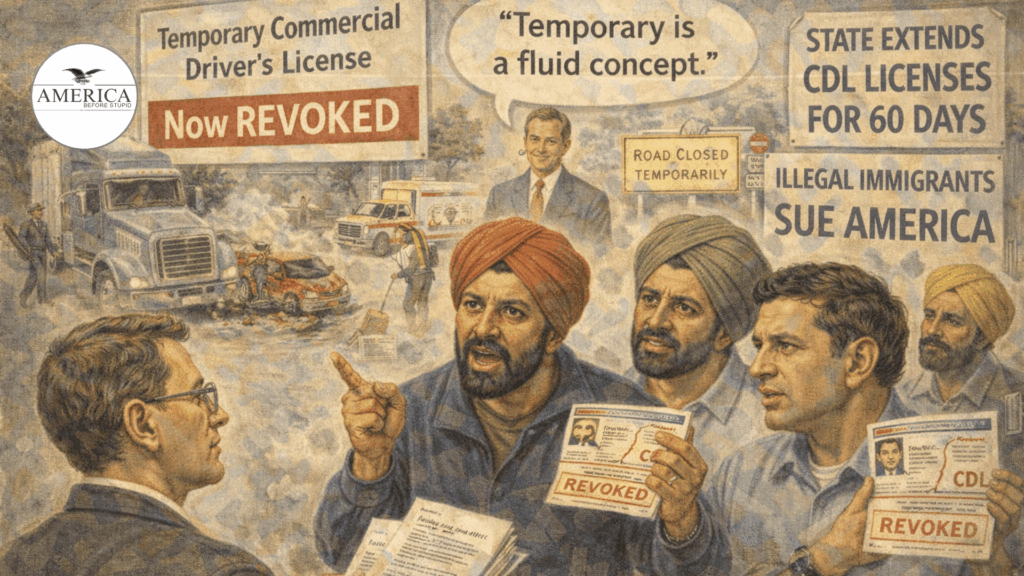
Federal authorities responded swiftly by announcing that the licenses were being revoked, citing their temporary nature.
That’s when the situation became educational.
The drivers, now represented by legal counsel, filed suit against the United States, arguing that since America granted the licenses in the first place, America has no right to take them back.
Legal experts say this position makes perfect sense under modern standards. “Temporary,” one analyst explained, “is a fluid concept. Much like borders, laws, and definitions.”
Complicating matters further, the state that issued the licenses announced it would extend them for an additional 60 days, just in case a solution could be “worked out.” Officials clarified that this extension applies even though the licenses were never intended to be permanent, the drivers were never intended to stay, and the program was never intended to exist long enough to cause lawsuits.
Transportation officials emphasized there is no cause for concern. “We are committed to public safety,” said one spokesperson, moments before reaffirming the temporary extension.
Critics argue the episode highlights a breakdown in accountability. Supporters counter that accountability itself can feel exclusionary.
At press time, lawmakers were reportedly exploring next steps, including:
- A Temporary Permanent License Program
- Road signs rewritten for universal interpretation
- And a legal framework clarifying that government mistakes are binding only on taxpayers
Officials reassured the public that lessons have been learned, though they declined to specify which ones.